



Tephrochronology of the NDT09 core in the Marsili basin: implicationsfor the timing and dynamics of volcanic eruptions of the southernTyrrhenian in the last c. 15 ka
Di Roberto A., G. Re, D.D. Insinga, B. Scateni, C. Caricchi, G. Siravo, M. Petrelli, G. Fisauli, A. Cascella, L. Bronzo, F. Lirer, P. Macrì, (2025).
Bulletin of Volcanology, 87:124. https://doi.org/10.1007/s00445-025-01911-3
Abstract
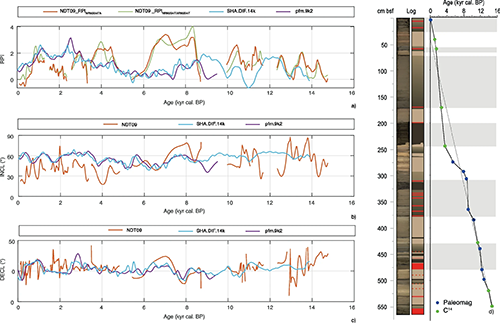
We report a detailed tephrostratigraphic characterization of the 5.7 m long NDT09 marine sediment sequence retrieved from the Marsili Basin in the southern Tyrrhenian Sea. Glass composition was determined through a combination of electron microprobe analysis (EMPA) and laser ablation inductively coupled plasma mass spectrometry (LA-ICP-MS), while textural analyses of tephra particles were conducted using scanning electron microscopy (SEM). This integrated approach led to the identification of 20 tephra and cryptotephra layers, characterized by a composition ranging from phonotephrite-tephriphonolite-fonolite-trachyte to rhyolite. The age of the tephra layers was estimated through radiocarbon dating (14C AMS) on foraminifera and paleomagnetic analyses, and an integrated age-depth model was developed. The integration of textural, chemical, and age constraints revealed a broad record of eruptions, sourced by different volcanoes surrounding the southern Tyrrhenian Sea, including Campi Flegrei, Somma-Vesuvius, Aeolian Islands, and Ischia. In particular, we identified the following eruptions for Campi Flegrei: Neapolitan Yellow Tuff (NYT), La Pigna 1, Soccavo 1, Pomici Principali, Fondi di Baia, and at least three undetermined eruptions. For the Somma-Vesuvius volcano, we recognized eruptions of Mercato, AP3, and 512 A.D.. For the Aeolian Islands, we recognized the activity of Vallone del Gabellotto of Lipari and an eruption within the Upper Brown Tuff phase of Vulcano. Lastly, we identified tephra from Cannavale and Arso eruptions sourced by Ischia. In addition, these results revealed important new insight into the eruptive history of individual volcanoes. First of all, three tephra layers attributed to Campi Flegrei eruptions have been identified within the chronostratigraphic interval between the NYT and La Pigna 1 eruptions. The lowermost layer, dated to c. 14.9 ka, displays a composition consistent with the NYT, while the other two do not correlate with any previously known tephrostratigraphic markers. Moreover, we confirmed that intense explosive activity at Lipari began around 13,000 years BP, culminating in the Vallone del Gabellotto activity—possibly characterized not by a single eruption, but by a series of closely spaced explosive events. Finally, southwestward dispersal of tephra from the 512 A.D. eruption of Vesuvius was documented, along with the identification of a previously unrecognized historical eruption in the Aeolian Islands, marked by a rhyolitic composition. Overall, this work provides a detailed reconstruction of the volcanic activity in the southern Tyrrhenian Sea over the past 15,000 years. These results enabled the identification of several eruptions, the refinement of age constraints, and the recognition of new and intriguing insights into deciphering the volcanic history of peri-Tyrrhenian volcanoes.
Devi effettuare l'accesso per postare un commento.