



Improving the reconstruction of Holocene geomagnetic paleosecular variation in the Antarctic region
Sagnotti L., C. Caricchi, P. Macrì, E. Colizza, P. Del Carlo, A. Di Roberto, A. Winkler, (2026).
Physics of the Earth and Planetary Interiors, 370, 12 pp. https://doi.org/10.1016/j.pepi.2025.107487
Abstract
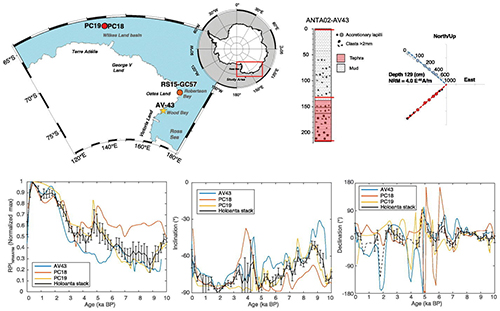
We present new paleomagnetic data from the ANTA02-AV43 core collected in the Ross Sea (Antarctica), spanning the last 10 ka. Results document a relative paleointensity (RPI) record that closely matches predictions from global geomagnetic models and from previously published records from nearby peri-Antarctic margins, including the Ross Sea and Wilkes Land Basin, covering the same time interval. The stratigraphic trends of directional paleomagnetic data from this study show features that are also consistent with global model predictions and earlier published data, supporting regional reconstructions of geomagnetic paleosecular variation (PSV). Notable differences reflect effects such as sedimentary inclination shallowing and the arbitrary restoration of magnetic declination in marine cores lacking azimuthal orientation.
We combined the new ANTA02-AV43 dataset with existing Holocene records from two additional sediment cores of comparable resolution to develop the paleomagnetic “HOLOANTA” stack. This composite record averages paleomagnetic data over the last 10,000 years in 200-year intervals. It includes RPI as well as paleomagnetic inclination and declination data, providing a robust regional Holocene RPI curve alongside directional secular variation (PSV) trends. The HOLOANTA stack serves as a novel tool to support high-resolution correlation between sedimentary cores and the development of detailed age models in marine sequences from the peri-Antarctic margins.
Devi effettuare l'accesso per postare un commento.