



Which is better: deep-learning or manual seismic arrival-time picking?
Cianetti S., A, Lomax, A, Michelini, C. Giunchi (2026).
Geophysical Journal International, Volume 244, Issue 3. https://doi.org/10.1093/gji/ggaf494
Abstract
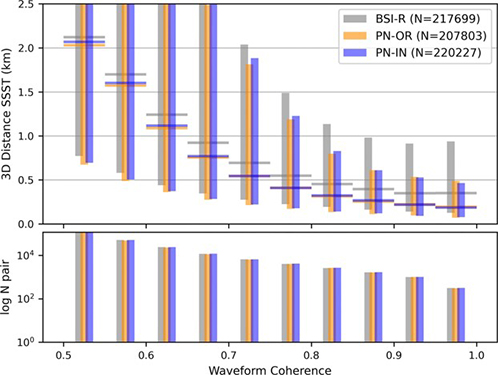
Earthquake locations and catalogues from routine earthquake monitoring are typically based on manually reviewed arrival-time picks from classical, rule-based automatic pickers. High-performance, deep-learning (DL) pickers can replace this standard approach, rapidly delivering much larger and complete catalogues. A transition to routine monitoring based on DL picks requires that resulting catalogues include all or almost all events identified by current procedures with locations of the same or higher quality. Here we verify these requirements by comparing the performance of DL and manual picking for earthquake relocation and tomographic inversion. We form a reference catalogue with a subset of INGV bulletin events and picks from the 2016 Central Italy sequence. This catalogue is re-picked using the DL picker PhaseNet trained on the Northern California Earthquake Data Center data set and on the INSTANCE Italian data set. We use these three pick sets for high-precision, nonlinear earthquake relocation and for 3-D tomographic inversion and relocation. Relative to the high-precision relocations using routine picks, those using DL picks show improved organization and clustering, and, in a ground-truth test, smaller hypocentre separation for event pairs with more similar waveforms. The tomographic inversions show statistically better convergence and more organized relocations using the DL picks than with the routine picks. We conclude that DL based monitoring can rapidly produce more consistent picks and higher quality catalogues than standard procedures, while freeing analyst time for improved quality control, assessment, interpretation and dissemination of information on seismic activity, especially during significant seismic sequences.
Devi effettuare l'accesso per postare un commento.