



The nucleation and growth of mixed H2O–CO2 bubbles in magmas
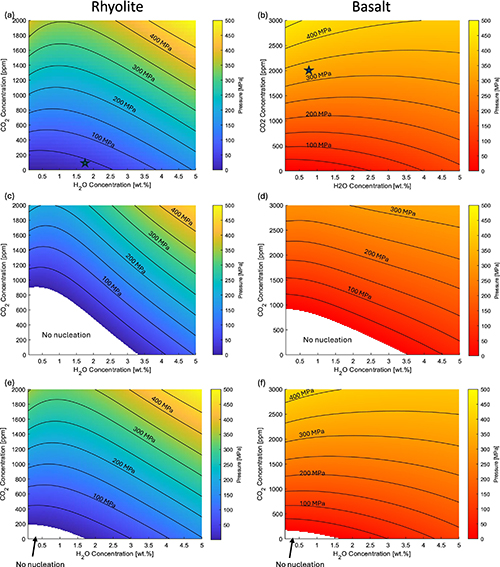
Figure 4. The critical pressure required for nucleation of bubbles in mixed H2O–CO2 systems…
Sullivan P., E.W. Llewellin, F.B. Wadsworth, S. Colucci, H. Kusumaatmaja (2026).
Journal of Volcanology and Geothermal Research, Volume 472. https://doi.org/10.1016/j.jvolgeores.2026.108538
Abstract
Volcanic eruptions are driven by the nucleation and growth of gas bubbles that form when volatile species dissolved in magma become supersaturated. Previous models for bubble growth have focussed on H2O; however, CO2 also plays a fundamental role in the nucleation and growth of gas bubbles. Here, we develop a numerical model to explore the nucleation and growth of bubbles containing both H2O and CO2 in magma of arbitrary composition. Nucleation is modelled as a Poisson process using classical nucleation theory with composition-appropriate solubility models for the mixed H2O–CO2 fluid. We find that CO2 dramatically increases the depth of bubble nucleation compared with H2O-only systems; for a case-study rhyolite (Krafla, Iceland) CO2 increases nucleation depth from 130 m (H2O-only) to 760 m if CO2 is included (a factor of 6 increase in nucleation pressure); for a case-study basalt (Fagradalsfjall, Iceland), nucleation occurs at 13 km depth if CO2 is included, but does not occur at all if H2O is the only volatile species. Post-nucleation growth of the bubbles is investigated by extending a ‘shell model’ to include CO2 as well as H2O. The species are coupled via a mixed equation-of-state for the gas phase, introducing a co-dependence on their solubility that allows H2O to exsolve at greater depth when CO2 is present. As a result, exsolution of a small volume of CO2 can trigger the exsolution of a much larger volume of H2O, driving rapid, disequilibrium bubble growth. Our findings show that accounting for mixed H2O–CO2 volatile compositions is essential for accurate modelling of magma ascent and eruption dynamics.
Devi effettuare l'accesso per postare un commento.