



Cognitive biases and rational decision making for volcanichazards and risks
Papale P. (2026).
Frontiers in Earth Science, 14 pp. https://doi.org/10.3389/feart.2026.1755833
Open access
Abstract
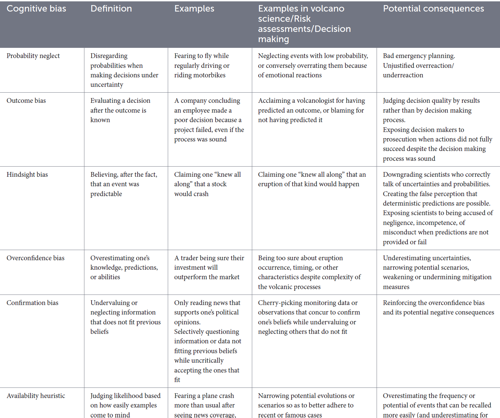
Volcanic systems are governed by complex, non-linear dynamics that make deterministic forecasting impossible and require decisions to be made under substantial uncertainty. This contribution examines how cognitive biases can distort volcanic hazard and risk assessment, and how such distortions can undermine both scientific judgement and civil protection decision making. After outlining the foundations of complexity and the implications for probabilistic forecasting, the paper discusses key biases–including probability neglect, outcome and hindsight biases, overconfidence, confirmation bias, and heuristics such as availability, representativeness, and normalcy–that are likely to emerge during unrest and crises. These biases can narrow the range of considered scenarios, promote misplaced confidence in specific outcomes, distort communication, and compromise the defensibility and accountability of decisions. The paper argues that rational, defensible decision making requires transparent, structured processes capable of integrating uncertainty rather than concealing it. Tools such as Bayesian event trees, expert elicitations, and cost–benefit analysis offer frameworks to formalise subjective expectations, broaden participation, document assumptions, and mitigate the influence of biases. Because volcanic risk management inevitably involves subjective objectives and incomplete knowledge, the goal is not to eliminate subjectivity but to make it explicit, scrutinable, and accountable. Developing and implementing decision-making protocols–analysed, tested, and communicated to the general public during periods of quiescence–can improve the quality, consistency, and transparency of decisions during crises. By recognising cognitive biases as inherent and unavoidable features of human reasoning, and by adopting structured methods to navigate them, volcano science and civil protection can better manage uncertainty and strengthen societal resilience to volcanic hazards.
Devi effettuare l'accesso per postare un commento.