



A speleothem record from the Fertile Crescent covering the last deglaciation better contextualizes neolithization
Regattieri E., L. Forti, R.N. Drysdale, H.-M, Hu, C.-C. Shen, I. Cornacchia, S. Agostini, I. Isola, C. Conati Barbaro, D. Morandi Bonacossi, R. Koliński, M.L. Griffiths, and A. Zerboni (2025).
Earth, Atmospheric, and Planetary Sciences Research in PNAS, 122(50). https://doi.org/10.1073/pnas.2502092122
Abstract
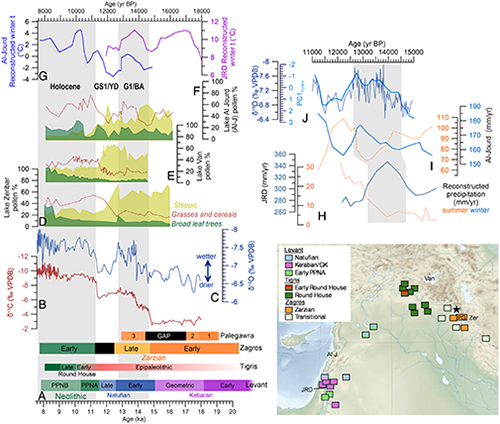
This study presents a high-resolution, multiproxy (carbon and oxygen isotopes, trace elements, and strontium isotopes) speleothem record from the Kurdistan Region of Iraq extending from the end of the Last Glacial Maximum (LGM) to the Early Holocene (18.0 to 7.5 ka), encompassing the Epipaleolithic–Neolithic transition in the core area of the Fertile Crescent (FC). The record shows that changes in local rainfall amount were coincident with changes in Greenland temperatures, with increased precipitation and enhanced multidecadal hydroclimatic variability during the Bølling–Allerød chronozone, followed by a drier and dustier Younger Dryas. Comparison with regional paleoclimate data suggests similar precipitation patterns across the FC, but with greater hydroclimate variability during the BA and drier conditions during the YD in the eastern sector. Crucially, the record provides a detailed and well-dated paleoenvironmental template by which to contextualize specific cultural events at the subregional scale, as revealed by recent archaeological research on key sites sharing similar environmental settings, allowing to investigate the role of climatic and environmental changes in shaping different neolithization patterns across the FC.
Devi effettuare l'accesso per postare un commento.