



PhD opportunity in High-Performance Scientific Computing and AI-enhanced CFD for volcanic flows
Applications open for Ph.D. 2026/2027 — Apply by August 10
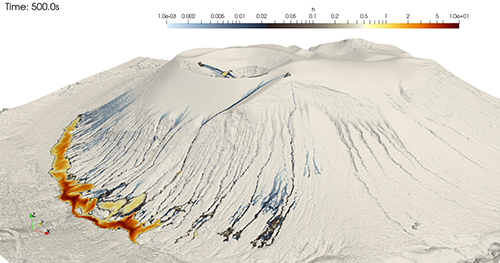
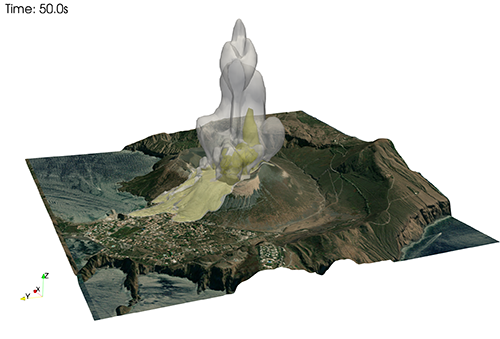
The Istituto Nazionale di Geofisica e Vulcanologia (INGV) is funding a PhD scholarship to be carried out within the PhD Programme in High Performance Scientific Computing (HPSC) at the University of Pisa. The PhD activities will be developed in close collaboration with the INGV Pisa Section, where part of the research activities will take place.
The HPSC PhD programme provides advanced interdisciplinary training in high-performance computing, artificial intelligence, numerical simulation, and scientific computing, with applications across mathematics, physics, engineering, environmental science, and other computational disciplines.
The scholarship is intended for highly motivated candidates interested in applying high-performance scientific computing, computational fluid dynamics, numerical modelling, and scientific machine learning to challenging problems in volcanic flow modelling and volcanic hazard assessment.
The project will focus on the development of advanced computational models for volcanic gas-particle flows, including pyroclastic density currents, lahars, pyroclastic avalanches, phreatic explosions, and related multiphase flows over complex topography. These phenomena involve a combination of multiphase fluid dynamics, turbulence, particle transport, thermal effects, interaction with complex terrain, and large uncertainty in initial and boundary conditions. They therefore provide a challenging and scientifically rich test case for modern computational science.
The PhD research may address different levels of the modelling chain, from three-dimensional multiphase CFD solvers to reduced or depth-averaged geophysical-flow models, depending on the candidate’s background and on the specific research direction selected. In all cases, the objective will be to combine robust physics-based numerical modelling with modern AI/ML techniques in a way that improves the scientific content, computational performance, or predictive capability of volcanic-flow simulations.
The project is not intended as a purely data-driven or black-box AI project. The successful candidate will not work only on the implementation of AI/ML techniques, but will actively contribute to the development of physics-based CFD and geophysical-flow simulation codes. AI and machine learning will be used as scientific and numerical tools to improve, accelerate, or enrich physically based models, while preserving interpretability, numerical robustness, and consistency with the governing physics.
Possible research directions include:
- development and improvement of multiphase CFD and depth-averaged solvers for volcanic flows;
- integration of AI/ML components into three-dimensional multiphase CFD models;
- learning physically constrained closures from numerical simulations or experimental/observational data;
- AI-assisted representation of unresolved or sub-grid physical and topographic effects;
- surrogate and reduced-order models to support larger simulation campaigns or ensemble studies;
- acceleration of selected components of physics-based solvers on modern HPC architectures;
- integration of scientific machine learning components into stable and scalable numerical codes.
The PhD activities will be embedded in a broader research environment involving national and European projects, collaborations with leading computational geoscience groups, and interactions with major high-performance computing centres. The candidate will have the opportunity to work on realistic volcanic-flow applications and to contribute to computational tools designed for modern HPC platforms.
Applications are particularly encouraged from students with a background in applied mathematics, computational physics, scientific computing, computer science, aerospace engineering, mechanical engineering, or related quantitative disciplines.
Previous experience in volcanology is not required. What is essential is a strong interest in numerical modelling, CFD, scientific programming, and the application of advanced computational methods to geophysical flows and natural hazards.
A strong candidate would have experience or interest in one or more of the following areas:
- numerical methods for partial differential equations;
- computational fluid dynamics, multiphase flows, turbulence, or geophysical flows;
- high-performance computing, parallel programming, GPU computing, or scientific software development;
- scientific machine learning, surrogate modelling, reduced-order modelling, or physics-informed AI;
- Python, C/C++, Fortran, or other scientific programming languages;
- Linux, version control, reproducible software development, or HPC environments.
The ideal candidate is someone who enjoys building and analysing computational models, is comfortable with mathematical and physical reasoning, and wants to work at the interface between CFD, HPC, AI/ML, and volcanic hazard science.
Interested candidates may contact federica.pardini@ingv.it.
Useful links
PhD Programme in High Performance Scientific Computing, University of Pisa:
https://www.dm.unipi.it/phd-hpsc/
Devi effettuare l'accesso per postare un commento.