



Volcaniclastic deposit failure as a source of pyroclastic density currents during the 1944 eruption of Vesuvius
Natale J., A. Falasconi, T. Oreade Grillo, A. Bevilacqua, G. Buono, M. Favalli, A. Fornaciai, A. Frontoni, G. Giordano, E. Intrieri, R. Nave, L. Pappalardo, A. Vona, F. Di Traglia (2026).
Volcanica, 9(2). https://doi.org/10.30909/vol/thmt5335
Abstract
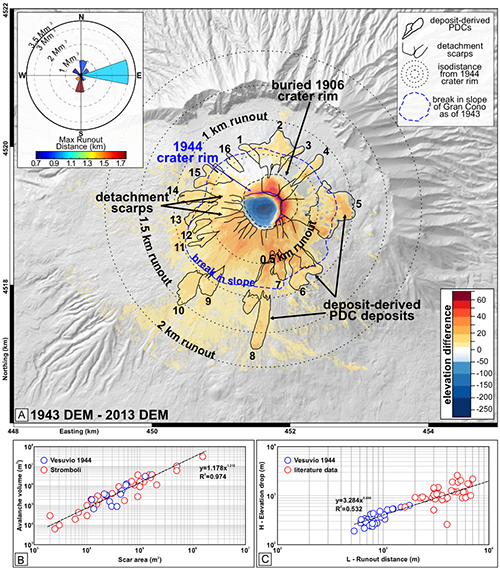
Pyroclastic density currents (PDCs) are among the most lethal volcanic phenomena and are mainly generated by column col-lapse, lateral blasts, or dome failure. An additional but still poorly constrained hazard is represented by PDCs produced by thecollapse of hot volcaniclastic deposits. Here we investigate deposit-derived (dd) PDCs emplaced during the 1944 eruption ofVesuvius (Italy). We integrate historical literature, contemporary written and photographic sources, and new field observationswith a reconstruction of the pre-eruptive topography based on vintage aerial photographs and digital elevation models. Ourresults show that the pre-eruptive crater geometry exerted a primary control on deposit accumulation, failure mechanisms, andrunout behaviour. Volume-area relationships indicate failure mechanisms broadly consistent with translational, near-planar col-lapse. Individual dd-PDCs reached volumes of up to∼3×10⁶m3and runout distances of∼1–1.5 km, ranking among the largestPDCs associated with sustained lava fountaining and highlighting an underestimated hazard capable of affecting areas up to2 km from the vent.
Devi effettuare l'accesso per postare un commento.