



The Medieval Climate Anomaly in the Balkans: Evidence from Golubarnica Cave in the Jakupica Massif (North Macedonia)
Zanchetta G., I. Isola, H.-M. Hu, M. Bini, A. Columbu, R. Drysdale, M. Luppichini, S. Natali, E. Regattieri, C.-C. Shen, N. De Santis, J. Hellstrom, C. Pennos, P. Natale, A. Masi, B. Wagner, I. Milevski, M. Temovski, A. Izdebsk (2026).
Palaeogeography, Palaeoclimatology, Palaeoecology, 695. https://doi.org/10.1016/j.palaeo.2026.113852
Abstract
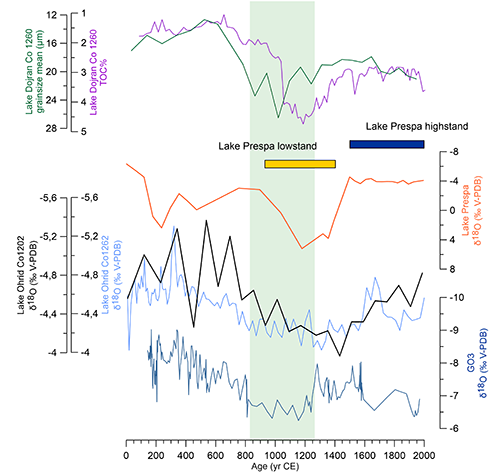
Current warming and human activity have negatively impacted the hydrological budget of some of the larger lakes in the Balkan region. To explore potential climatic analogues for the recent climatic period we investigated a speleothem record from Golubarnica Cave in North Macedonia focusing on hydrological changes occurring during the Medieval Climatic Anomaly (MCA). The δ18O record and petrography identify a period of drier conditions between ca. 800 and 1250 CE, chronologically consistent with the MCA. This is broadly consistent with lake lowstands in lakes Prespa and Dojran obtained by geomorphological, sedimentological and diatom data, as well as increasing evaporation at lakes Prespa and Ohrid inferred by δ18O of endogenic lacustrine calcite. Taken together, these observations point to an extensive effect of the MCA-related hydrological anomaly over the Balkan region, which occurred during a period of persistent positive North Atlantic Oscillation (NAO). Our results offer an important analog for comparing the regional response under the ongoing pressure of global warming.
Devi effettuare l'accesso per postare un commento.