




Central Mediterranean tephrochronology and explosive volcanism over the240–190 ka interval: Insights from the high-resolution record of CastiglioneMaar, central Italy
Scateni B., G. Re, G. Di Vincenzo, B. Giaccio, P. Macrì, M. Petrelli, A. Di Roberto* (2026).
Quaternary Science Reviews, 382, 22 pp. https://doi.org/10.1016/j.quascirev.2026.109959
Abstract
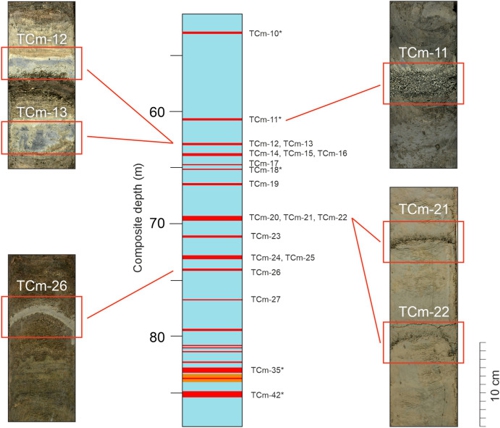
A comprehensive tephrochronological study was carried out on the paleo-lacustrine sedimentary sequence of the Castiglione Maar, located in the Colli Albani volcanic district (Lazio, Italy), and focused on the Marine Isotope Stage 7 (MIS 7; approximately 243–190 ka). Identified tephra layers were characterised for texture, mineral content, glass chemistry (major, minor, and trace elements), and dated by the 40Ar/39Ar method. The volcanic sources of the investigated tephra have been identified in the Sabatini Volcanic District and the Latera Volcanic Complex in the Vulsini District, with a smaller contribution from the Campanian province (Ischia) and Colli Albani District. Specifically, we identified tephra from the Vigna di Valle eruption (40Ar/39Ar age 199.54 ± 0.43 ka, ±2σ), along with four tephra from presently unknown eruptions of the Sabatini Volcanic District. Particularly well-expressed and represented is the activity of the Latera Volcanic Complex, with tephra layers deriving from the eruption of Upper Grotte di Castro (modelled age 216.30 + 1.24/-1.88 ka, ±2σ), Sorano (modelled age 220.8 + 1.7/-2.0 ka), Farnese (modelled age 234.8 + 1.3/-2.1 ka and 234.4 + 1.5/-2.2 ka), and Stenzano (modelled 240.5 + 2.1/-2.0 ka). Six additional unknown eruptions from the Latera activity were found together with the above-listed well-defined ones, one of which was dated by the 40Ar/39Ar method at 219.98 ± 0.44 ka. This highlights a more complex history of the Latera caldera. In particular, many of the identified well-known eruptive units were not single explosive events (i.e., single tephra). Instead, they testify a sequence of highly energetic events, separated by hundreds to thousands of years (multiple stacked tephra beds), sharing similar, yet geochemically barely distinguishable, glass compositions and mineralogical assemblages. Results allow a more complete reconstruction of the explosive history of Italian volcanoes during the MIS 7 and integrate the regional tephra framework by introducing several new chronostratigraphic markers. These geochronological constraints are crucial to establishing a robust age model for the Castiglione maar sequence and refining the history of Latera caldera.
Devi effettuare l'accesso per postare un commento.