




High-frequency volcano seismic tremor at Mt. Etna, Italy: Insights from varying seismic-acoustic amplitude ratios
Weber M., J.C. Bean, I. Lokmer, S. De Angelis, L. Zuccarello (2026).
Journal of Volcanology and Geothermal Research, 472, 13 pp. https://doi.org/10.1016/j.jvolgeores.2026.108578
Abstracy
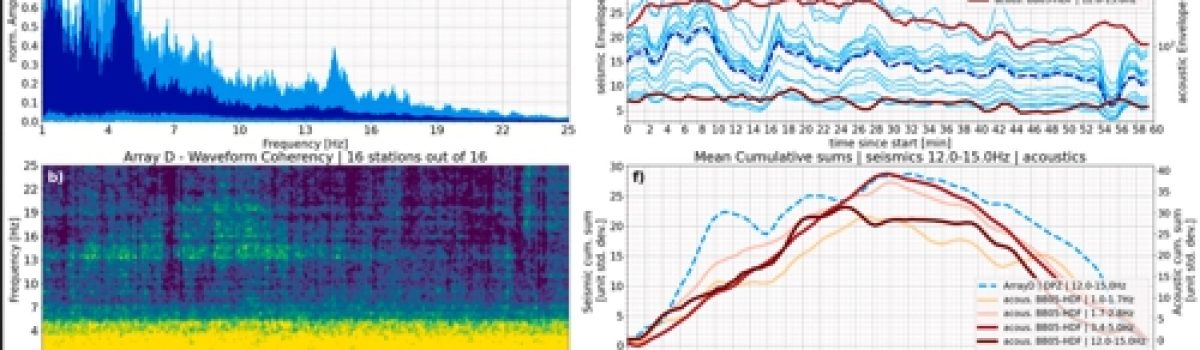
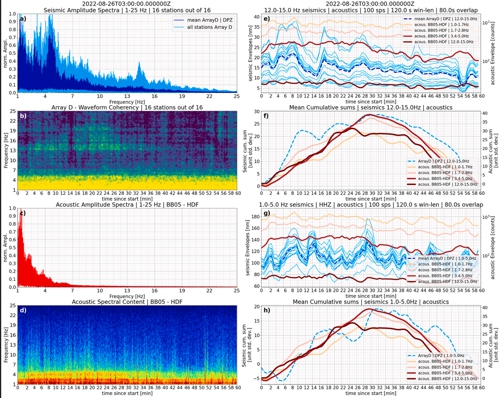
We present a comprehensive, high-resolution seismic and acoustic datasets from Mt. Etna, Italy acquired through a large, unprecedented deployment of seismometers and microphones in the summit region during summer 2022, highlighting about 50 rarely reported high-frequency (12–15 Hz), short-duration, minute- to half an hour-long volcanic seismic tremor episodes. These events exhibit variable seismic-acoustic amplitude ratios, implying multiple triggering mechanisms. Evidenced by coincident acoustic signals at different distinct frequencies our analysis suggests that while some tremor occurrences are indirectly associated with degassing processes other examples of high-frequency tremor lack any acoustic counterpart, indicating that vigorous degassing and thus fluid migration might not be a primary driver for tremor generation. We propose that in addition to traditional models requiring fluid movement for tremor generation, quasi-brittle, mesoscale failure within weak edifice material may act as a direct source mechanism radiating high-frequency tremor. This interpretation aligns with prior studies on numerical simulations of seismic event generation in typical low-stiffness volcanic materials as well as laboratory experiments with volcanic samples under stress and helps explain shallow seismic tremor episodes in the absence of acoustic signals.
Devi effettuare l'accesso per postare un commento.