




Twenty‐Five Years of Probabilistic Fault DisplacementHazard Assessment
Valentini A., F. Visini, P. Boncio, O. Scotti, and S. Baize (2025).
Reviews of Geophysics, 63. https://doi.org/10.1029/2024RG000875
Open access
Abstract
Earthquakes can break the surface, leading to ground displacement that
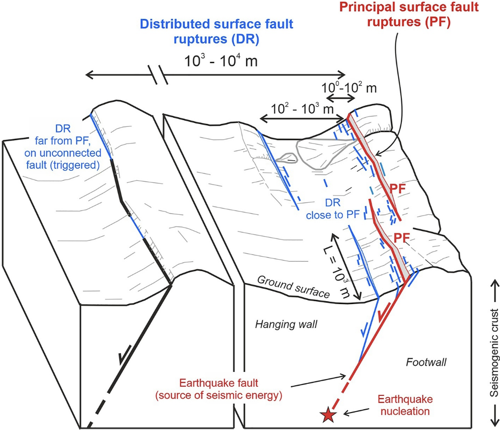
can damage buildings, roads, pipelines, and other critical infrastructure. Understanding andassessing how much and where the ground might break the surface is essential for reducing risks. Probabilistic Fault Displacement Hazard Assessment (PFDHA) is a method used to estimate the likelihood and extent of surface rupture due to earthquakes. Since its introduction, PFDHA has evolved with new models and data sets, but significant challenges remain. This review compiles all PFDHA models, discussing their strengths, limitations, and applicability to different fault types. We highlight the need for standardized terminology, improved databases, and the integration of advanced techniques such as remote sensing, machine learning, and physics‐based modeling. Additionally, we emphasize the importance of developing a unified computational framework to
ensure reproducibility and consistency in hazard assessments. By addressing these challenges, the field can progress toward more reliable predictions, ultimately improving the resilience of infrastructure and communities in earthquake‐prone regions.
Devi effettuare l'accesso per postare un commento.