



Assessing deposit-derived pyroclastic flow hazard at Stromboli (Italy): 1. Reconstruction of the dynamics of the 11 September 1930 event
Neri A., A. Bevilacqua, Z. Geddo, L. Corna, M. de’ Michieli Vitturi, A. Di Roberto, F. Di Traglia, M. Pompilio, A. Bertagnini, F. Flandoli, A. Tadini, (2026).
Journal of Geophysical Research: Solid Earth, 131, e2025JB032568. https://doi.org/10.1029/2025JB032568
Abstract
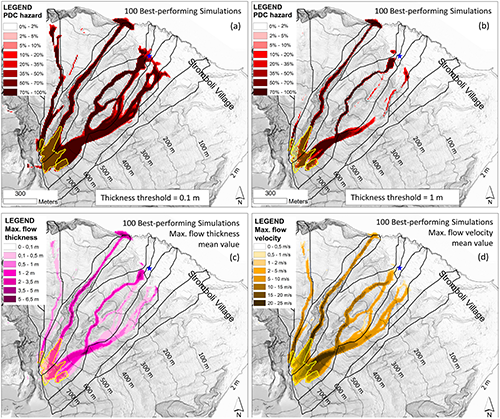
Stromboli volcano (Italy) is known for its persistent explosive activity punctuated by more energetic explosions called paroxysms. During paroxysms, pyroclastic density currents, triggered by the gravitational instability of hot pyroclastic deposits, can occur. These flows have the potential to take place beyond the Sciara del Fuoco, a topographic depression on the northwest flank, posing a direct hazard to residents and climbers. Historical examples of these flows include those which occurred during the 1930 and 1944 paroxysms. This study aims at deepening our understanding of the 11 September 1930 event by integrating new field observations, historical records, and numerical modeling also producing a first probabilistic reconstruction of the phenomenon. Recent erosive floods have revealed previously unseen flow deposits in the San Bartolo valley, complementing those identified in the Vallonazzo basin. We have utilized these new field data and eyewitness accounts to estimate maximum flow thickness at various locations along these valleys. Using a shallow-water model of the dense granular flow alongside an inversion algorithm, we show that the main flow moved predominantly through these valleys, with possible further flows in the nearby basins. Consistently with evidence, the reconstructed Vallonazzo flow reached the sea while the San Bartolo flow halted near the local church. The estimated remobilized volume ranged 34,000–59,000 m3. Our findings indicate that the areas affected are highly dependent on the source location. Based on these results, in the companion paper (Bevilacqua, Neri, Bertagnini, et al., 2026, https://doi.org/10.1029/2025JB032571), the hazard of this phenomenon was assessed over the entire Stromboli Island.
Devi effettuare l'accesso per postare un commento.