



Field characterization and numerical modelling of a new historical deposit-derived pyroclastic density current at Punta Labronzo, Stromboli, Italy
Corna L., A. Bevilacqua, M. Pompilio, A. Neri, M. de’ Michieli Vitturi, A. Di Roberto, F. Di Traglia, G. Re & A. Tadini (2026).
Bulletin of Volcanology, 88(65). https://doi.org/10.1007/s00445-026-01988-4
Abstract
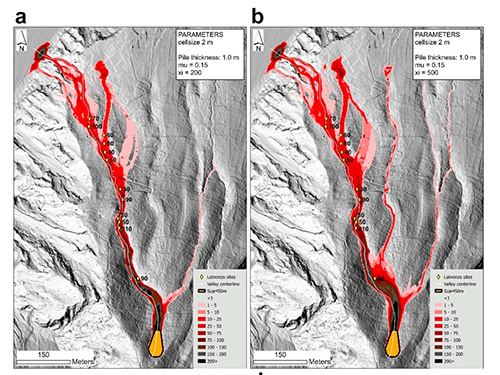
Stromboli volcano (Italy) exhibits a persistent, low-intensity activity, but can occasionally produce more powerful eruptions. These paroxysms can generate pyroclastic density currents usually confined in the Sciara del Fuoco, a horseshoe-shaped depression about 2 km from inhabited areas. However, at least twice in modern times (1930 and 1944), PDCs occurred outside the Sciara del Fuoco, rising the hazard impact. This study focuses on a small valley adjacent to the Sciara del Fuoco in the Punta Labronzo area, crossed by a popular touristic path. There, recent precipitations unveiled a previously unknown, ≈1 m thick, massive PDC deposit. The collected samples contain older accretionary lapilli engulfed by the flow, angular clasts and non-abraded spatters all along the runout, and very low fine ash content. By performing depth-averaged flow modelling, we tested different assumptions on the initial volume, basal friction, and turbulent dissipation parameters and compared them to field data for a qualitative validation. The simulations showed that the Labronzo PDC had a very low volume in the order of 10^3 m3, generally low-moderate velocities (< 10 m/s), a reduced basal friction and limited turbulent dissipation. These relatively slow dynamics limited abrasion processes, preserving accidental accretionary pellets and inhibiting fine ash generation. Major element chemistry revealed that the composition of the juvenile clasts is the same as juvenile clasts from a paroxysm in the sixteenth century, though radiocarbon analysis of charcoal pieces revealed an age closer to the eighteenth century. This makes the Labronzo PDC a new instance of a PDC outside the Sciara del Fuoco in modern times, different from 1930 and 1944.
Devi effettuare l'accesso per postare un commento.