



A probabilistic assessment of tephra hazards inAntarctica reveals implications for polar logistics andSouthern Hemisphere aviation
Pardini F., · P. Del Carlo, · A. Di Roberto (2026).
Nature – Scientific Reports. https://doi.org/10.1038/s41598-026-69650-9
Abstract
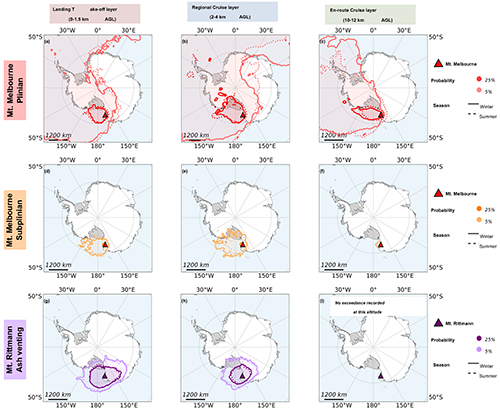
Antarctica hosts globally connected research infrastructure and critical aviation corridors, yet its volcanic haz-ard exposure remains largely unquantified. We present the first probabilistic hazard assessment for Mt. Mel-bourne and Mt. Rittmann in Northern Victoria Land. By integrating 20 years of high-resolution meteorological reanalysis with tephra transport simulations, we quantify impacts from airborne ash and ground fallout. We show that eruptions injecting tephra into the stratosphere can cause long-range dispersal, affecting tens of millions of square kilometers of Southern Hemisphere airspace and intersecting major intercontinental flight routes. Meanwhile, moderate tropospheric eruptions produce regional ash clouds capable of disrupting intrac-ontinental flights. Ground-level fallout, even millimetric accumulations, can severely impact critical infrastruc-ture, disrupting power generation, contaminating water, and reducing runway operability. Ultimately, this study emphasizes the necessity of integrating volcanic hazards into Antarctic contingency planning.
Devi effettuare l'accesso per postare un commento.