



Chronology, morphometric analysis and grainsize distributions of the sequence of lahars that occurred on the ESE flank of Stromboli (Italy) in 2024 – 2025
Bevilacqua A., A. Fornaciai, L. Corna, M. Favalli, P. Gabellini, L. Nannipieri, A. Neri & M. Pompilio (2026).
Bulletin of Volcanology, 88, 121. https://doi.org/10.1007/s00445-026-02045-w
Abstract
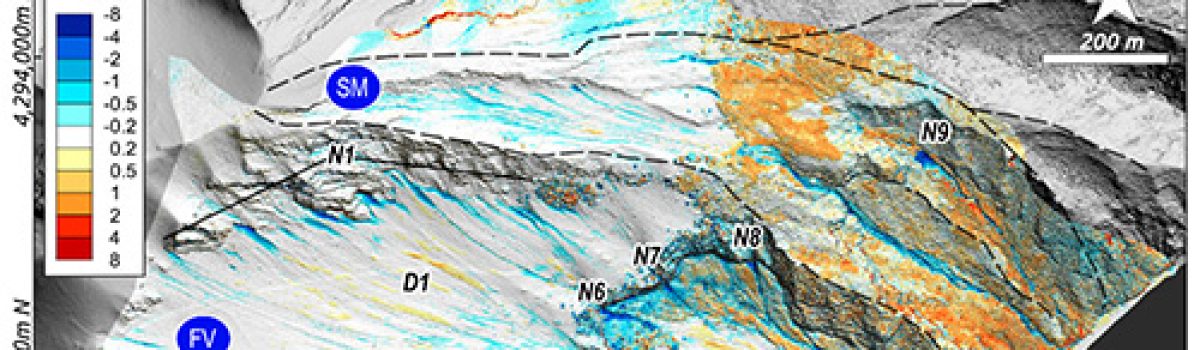
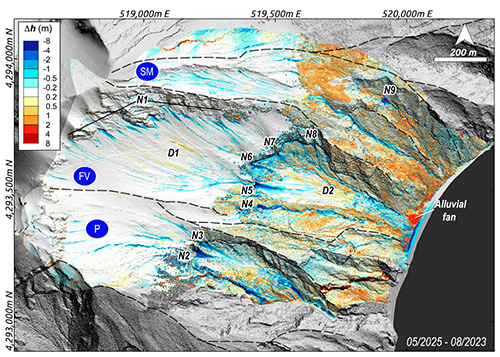
Abstract: This study presents a multidisciplinary data acquisition and analysis of a lahar sequence on the unpopulated ESE flank of Stromboli volcano, starting with the paroxysm of July 11th, 2024. Based on the reconstructed chronology of lahar events, we quantified volume changes on the ESE flank and analyzed the grain size distribution of the resulting deposits. We hypothesize that the July lahar phase was syn-eruptive with the paroxysm and we document at least two post-eruptive lahar phases between August and October/November 2024. We quantified the material that fed these lahars, mainly detached from various niches in the Rina Grande area and below the scarp located at ≈400 m a.s.l., for a total of (1.8 ± 0.6) × 10^4 m3 volume loss. We also mapped multiple alluvial fans downstream, totaling (1.6 ± 0.4) × 10^4 m3. The July lahars deposited a 10 cm fines-rich unit fluid enough to travel between the reeds without flattening them and percolated between individual beach gravels. Subsequent lahars were more voluminous, sedimenting units up to 6 m thick and alluvial fans up to 250 m wide, though rapidly eroded by tidal waves. These secondary flows featured progressively coarsening grain-size distributions. Our findings address a knowledge gap regarding lahar characteristics and emplacement on steep, basaltic-to-intermediate volcanic islands. Although operating on relatively small volumetric scale (of the order of 2 × 10^4 m3 solid fraction), these post-eruptive flows pose a persistent and significant threat to inhabited coastal areas whenever volcanic activity limits ground permeability on steep volcanic flanks.
Devi effettuare l'accesso per postare un commento.