



Lahars at Stromboli volcano (Italy): insights from field and sedimentological data
Gianardi R., D. Andronico, M. Pistolesi, C. Spinetti, M. Bisson (2026).
Annals of Geophysics, 69. https://doi.org/10.4401/ag-9547
Abstracy
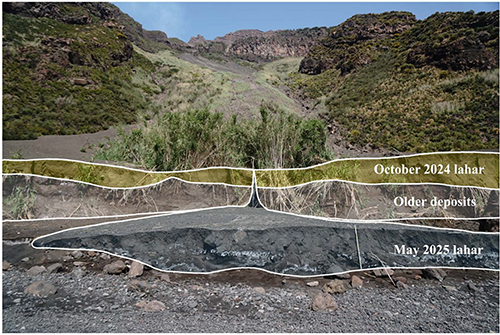
Stromboli, one of the most active volcanoes in Italy, is characterized by an ordinary eruptive activity consisting of persistent and mild explosions, occasionally interrupted by lava flows and by significant eruptions named major explosions and paroxysms. During such explosive activity, abundant loose pyroclastic material is emplaced on the upper steep slopes of the volcano. Due to intense or prolonged rainfall, this material can be remobilized, thereby generating volcanoclastic flows of different typologies that invade the lower slopes and, in several cases, reach the inhabited coastal areas causing huge damage to infrastructures. The most recent flows occurred on October 18‑20, 2024 and May 15, 2025, when Stromboli island was hit by very intense rainfall concentrated in a few tens of minutes. Consequently, loose tephra deposits were rapidly remobilized, triggering lahars that reached the villages of Stromboli and Ginostra, as well as the access routes to the volcano summit. In this work, for the first time, the grain‑size characterization of these lahar deposits is presented. Based on the sedimentological characteristics and grain‑size distributions the deposits have been classified as hyperconcentrated stream flows and proves to be dominated by coarse to fine ash. Moreover, using high‑resolution Pleiades optical satellite data, one of the depositional fans sampled during fieldwork was characterized. The results of this study provide the first quantitative grain‑size dataset for Stromboli lahars, representing a key constraint for the reconstruction and numerical modeling of these processes in volcanic hazard assessment at Stromboli.
Devi effettuare l'accesso per postare un commento.