



Magneto-biostratigraphic dating of the marine-terrestrial transition in the Miocene Sivas Basin (Central Anatolia): Implications for Neo-Tethys seaway closure and Eurasia-Arabia collision
Özkaptan M., D. Gürer, E. Gülyüz, A. Cascella, Mariu.s Stoica, W. Krijgsman (2026).
Tectonophysics, 932. https://doi.org/10.1016/j.tecto.2026.231220
Abstract
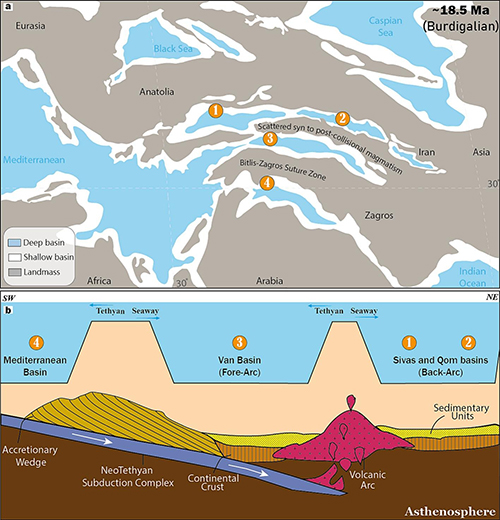
Transitions from marine to continental sedimentation provide some of the most direct geological evidence for the final stages of ocean closure. In this study, we focus on the Miocene sedimentary succession of the Sivas Basin in Central Anatolia, which was part of the ancient Neo-Tethys seaway that connected the Indian Ocean with the Mediterranean. We present paleomagnetic and biostratigraphic (ostracods and calcareous nannofossils) data of the Sürek Section that contains a gradual transition from deep-marine marls to continental clastics. Our ostracod data show long-ranging, deep marine species at the basal parts of the section changing upwards to shallower and more diverse assemblages. Our calcareous nannofossil data indicates that the marine-continental transition, and thereby the onset of terrestrial sedimentation following the termination of the Neo-Tethys seaway in the Sivas Basin, is dated in the middle Burdigalian at an age of 18.5 ± 0.5 Ma. Paleomagnetic analyses yielded only normal polarities, indicating a pervasive remagnetization has taken place after deposition. Anisotropy of magnetic susceptibility (AMS) measurements show a distinct change from extensional to contractional deformation concurring with the marine to continental transition. We hypothesize this change is caused by modifications in the Eurasia-Arabia stress regime that shows a transformation from subduction to collision processes during the Early Miocene in Central Anatolia.
Devi effettuare l'accesso per postare un commento.