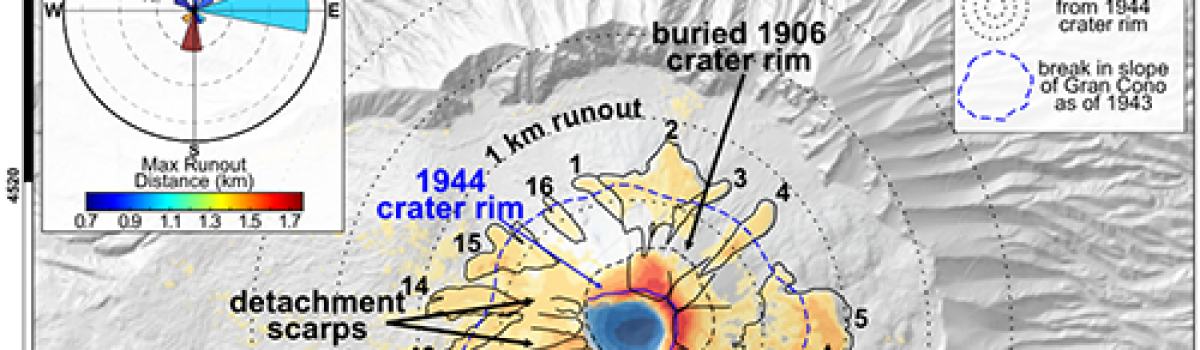
Best two simulations of the Labronzo PDC, with a 1 m pile thickness, a basal friction coefficient of 0.15 and a turbulent dissipation parameter of (a) 200 and (b) 500 m/s2. Outcrops are depicted as yellow diamonds, with their measured thickness value attached (in cm). The centreline of the valley…
News
Lahars at Stromboli volcano (Italy): insights from field and sedimentological data
Figure 8 Stratigraphic relationship between the lahar deposit at Schicciole Beach after the May 15, 2025 events. In chronological order: older pre‑2024 deposits (white), overlain by the October 2024 lahar deposits (yellow). The sequence is subsequently cut by the depositional fans formed during the May 2025 event (blue). Photo by…
Assessing deposit-derived pyroclastic flow hazard at Stromboli (Italy): 2. Probabilistic invasion maps
Enlargement of the NE quadrant of the island of Stromboli, illustrating the PDC invasion probability maps conditioned on the collapse of a random circular sector of 20° width, with respect to a maximum flow thickness threshold of 0.1 m. Basins 1-4 are labeled and shaded in yellow, Sites 1-3 are…
Assessing deposit-derived pyroclastic flow hazard at Stromboli (Italy): 1. Reconstruction of the dynamics of the 11 September 1930 event
Probabilistic reconstruction of the areas invaded by the dense current of the 1930 PDC event, showing the likelihood of exceeding (a) 0.1 and (b) 1 m flow thickness threshold during the entire propagation. In panel (c) we show the mean value of maximum flow thickness, and in panel (d) the mean value of the maximum…
Magneto-biostratigraphic dating of the marine-terrestrial transition in the Miocene Sivas Basin (Central Anatolia): Implications for Neo-Tethys seaway closure and Eurasia-Arabia collision
Fig. 9. a) Simplifield paleogeographic reconstruction of the eastern Mediterranean region during the middle Burdigalian, modified from Palcu et al. (2023). The figure illustrates the terminal stage of Neo-Tethys marine connectivity and the early collision between Arabia and Anatolia. Magmatism north of the Zagros suture is represented as localized…
Central Mediterranean tephrochronology and explosive volcanism over the240–190 ka interval: Insights from the high-resolution record of CastiglioneMaar, central Italy
Figure 3 Composite sequence tephrostratigraphy for the studied Marine Isotope Stage (MIS) 7 interval. The figure illustrates the stratigraphic positions of the studied tephra layers plotted against composite depth (m). High-resolution photographs display representative tephra layers from core C1-C2 (highlighted by red rectangles), illustrating their primary stratigraphic features and visual…
Devi effettuare l'accesso per postare un commento.